How to Sell a Warehouse in Miami for the Highest Price
To sell a warehouse in Miami for the highest price, owners should do five things well: sell into real buyer demand, prepare the asset before it goes to market, price it strategically, market it to the right buyer pool, and negotiate for net proceeds rather than headline price alone. That matters in Miami because industrial demand is still healthy, but the market is no longer the ultra-tight environment it was a few years ago. Vacancy has risen as new supply delivered, while rents remain elevated and small-bay product has continued to outperform larger-format space.
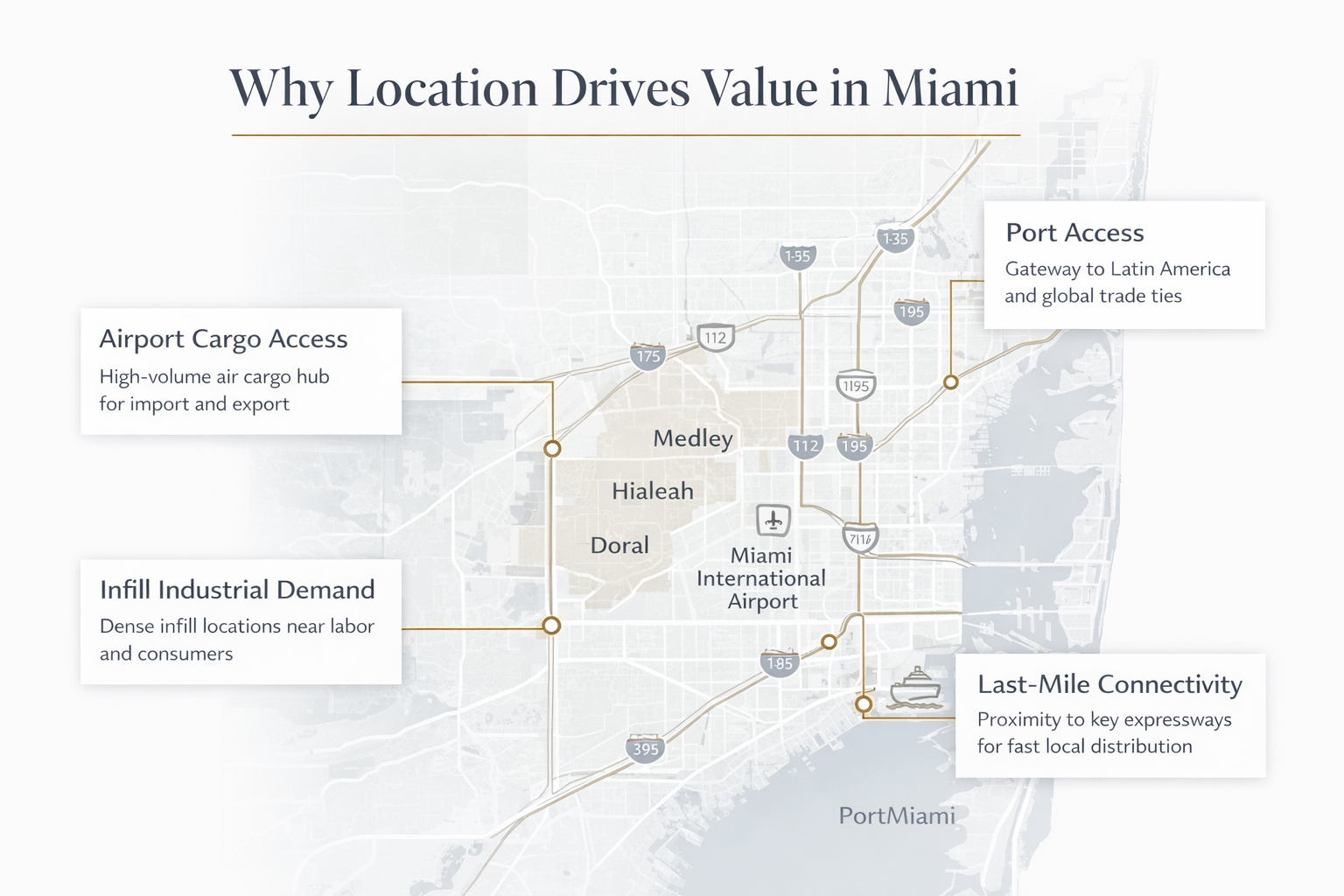
Miami is still one of the most compelling warehouse markets in the country because it sits on top of powerful logistics drivers. PortMiami processed about 10.1 million tons of cargo and 1.09 million TEUs in fiscal 2024, while Miami International Airport handled a record 3 million tons of freight in 2024 and says it is America’s top airport for international air freight. That freight activity supports ongoing demand from importers, exporters, freight forwarders, food users, e-commerce, and distribution tenants.
The challenge for sellers is that a strong market does not automatically produce the highest price. In a more selective environment, buyers pay premiums for the right buildings and discount the ones that feel hard to lease, operationally obsolete, or poorly packaged. Recent market reports show Miami-Dade industrial vacancy in the mid- to upper-single digits depending on the dataset and submarket, while rents have stabilized at high levels rather than accelerating the way they did during the peak run-up. That means execution matters more than ever.
Start with what buyers are paying for now
The first step is understanding what today’s buyer actually wants. In Miami, that often means location, functionality, and flexibility.
A warehouse near the airport, PortMiami corridors, Doral, Medley, Hialeah, or key expressway access points usually has a stronger value story because it reduces transportation time and improves last-mile and import-export efficiency. Functional features also matter: clear height, truck loading, turning radius, parking, fire protection, and overall site flow can materially change how buyers underwrite the property. In a market where tenants have more options than they did when vacancy was near its lows, inferior functionality can show up quickly in pricing. Miami’s vacancy hit 5.7% in early 2025 in CBRE’s tracking, and Colliers reported 6.8% by Q4 2025 as deliveries pushed the market into a recalibration phase.
That is why owners should position the asset around its best use, not just its square footage. A small-bay warehouse with strong infill access may deserve a different buyer strategy than a big-box distribution building. Colliers reported that Miami’s small-bay sector remained especially resilient, with vacancy around 2.3% to 3.0% versus materially higher vacancy in the big-box segment.
Prepare the property before going to market
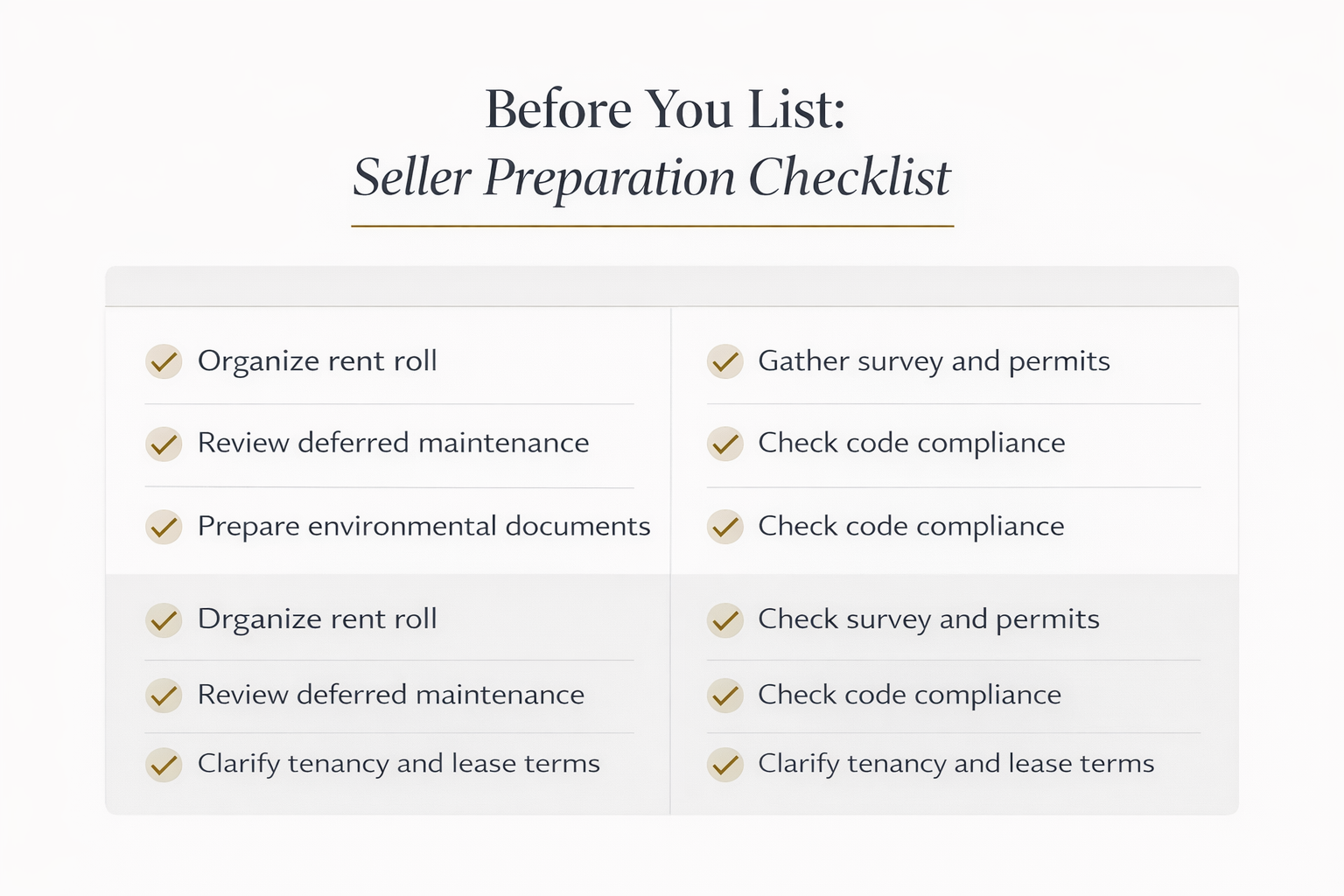
The highest-price sales are usually won before the listing goes live. Buyers pay more when the property feels easy to underwrite and easy to close.
That means cleaning up deferred maintenance, making sure the roof, paving, lighting, and loading areas present well, and organizing every key document in advance. At minimum, sellers should be ready with rent rolls, operating statements, surveys, site plans, permits, environmental reports if available, and a clean explanation of any code, title, or deferred-maintenance issues. A buyer will almost always discover problems during diligence. The pricing question is whether they discover them early, with context, or late, as a surprise.
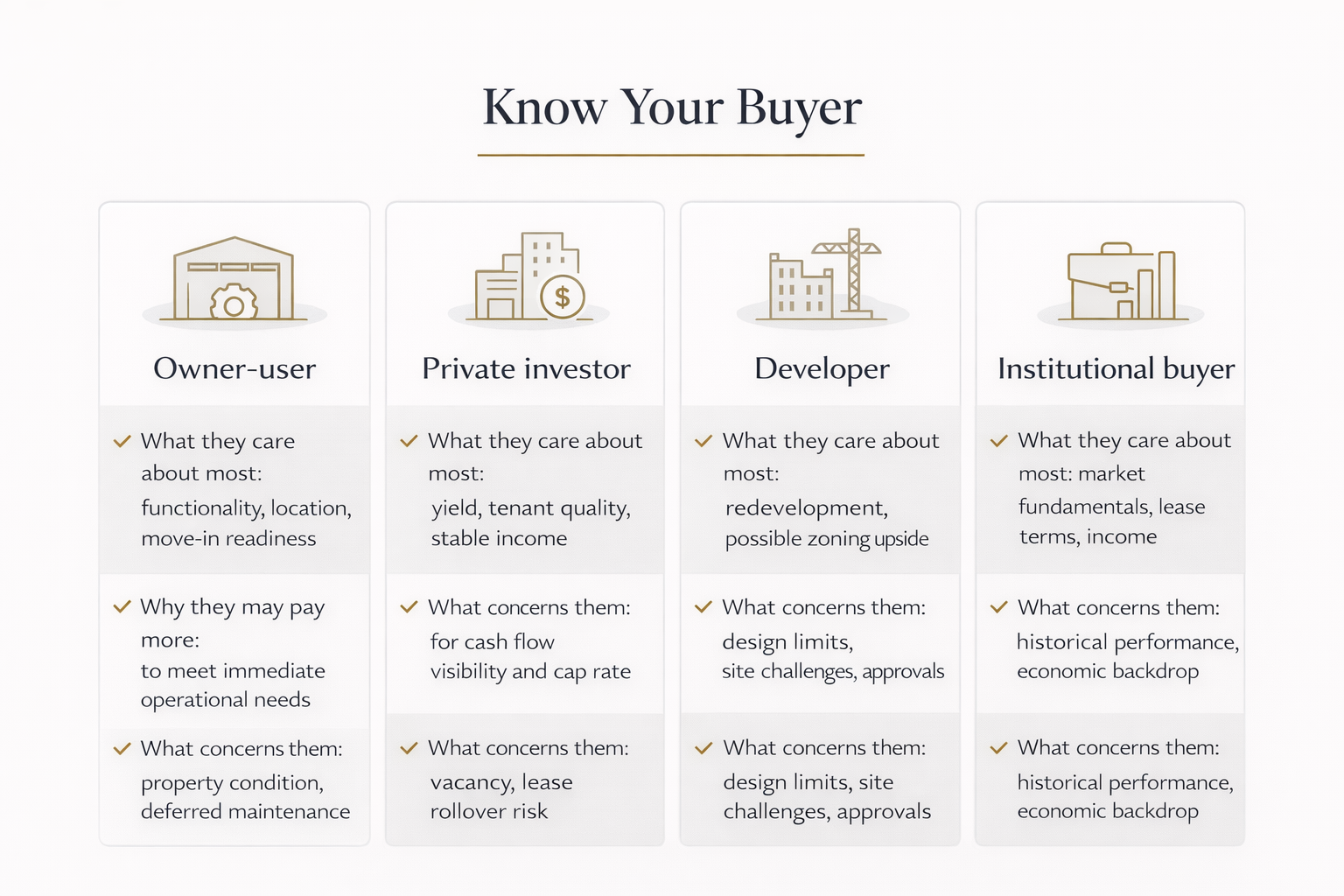
This matters even more in Miami because the buyer pool is broad. Private capital remains a major force in industrial acquisitions nationally, and owner-users have also increased their share of purchases. Different buyers will focus on different risks, so a well-prepared diligence package widens the pool and improves confidence. Newmark reported that private capital accounted for nearly half of industrial acquisitions nationally in 2Q 2025, while users reached a 10% share.
Price strategically, not optimistically
Many warehouse owners lose value by confusing a strong market with unlimited pricing power. The best pricing strategy is not “ask for the moon.” It is “set the market up to compete.”
Miami’s industrial market is still active. Cushman & Wakefield reported 7.7 million square feet of new leasing activity in 2025, up 12% year over year, and nearly 1.9 million square feet of annual net absorption. At the same time, new deliveries lifted vacancy, and rents have started to stabilize rather than sprint higher. Colliers reported Miami-Dade rents at $16.74 per square foot NNN in Q4 2025, up 1.8% year over year but down slightly from the prior quarter.
That mix tells sellers something important: buyers still want Miami industrial, but they are underwriting more carefully. Overpricing can reduce tours, slow momentum, and make buyers wonder what is wrong with the asset. Strategic pricing, by contrast, can create urgency, multiple offers, and stronger terms.
In practice, that means looking at recent comparable sales, current competing listings, lease-up risk, replacement cost, and buyer profile. A fully leased infill warehouse with durable cash flow may justify a pricing strategy aimed at investors. A vacant, highly functional building in a tight user pocket may be better sold to an owner-user willing to pay for occupancy rather than yield.
Tell a sharper story than competing listings
The average warehouse listing says very little. It mentions the size, the office percentage, and maybe the loading count. That is not enough.
To push pricing higher, the marketing story has to explain why this asset is hard to replace and why demand should persist. In Miami, the strongest stories often connect the property to freight infrastructure, labor access, trade flows, and local scarcity. PortMiami’s cargo throughput and MIA’s freight volumes are not just interesting statistics. They are proof points that help explain why industrial users continue to value well-located warehouse space in the region.
Your marketing should also highlight what is rare about the property. That could be excess land, trailer parking, outside storage potential where legally permitted, cooler capacity, higher power, infill location, or redevelopment optionality. A buyer premium is usually tied to scarcity, not to generic attributes.
Run a process, not just a listing
The highest price usually comes from competition, not convenience. That means targeted outreach to private investors, local owner-users, family offices, regional operators, and institutional groups that are active in South Florida industrial.
The data supports that there is still depth in the market. Colliers noted robust investor interest in Q4 2025 despite lower overall sales volume, citing notable transactions including Basis Industrial’s roughly $84.8 million purchase of a Hialeah small-bay portfolio.
A disciplined process typically includes controlled buyer outreach, a clear timeline, property tours, a bid date, and a best-and-final round when warranted. That structure does two things: it exposes the property to the right capital and it reduces the chance that one buyer controls the conversation too early.
Negotiate for certainty and net proceeds
The highest offer is not always the best deal.
A seller should evaluate earnest money, hard-money timing, due-diligence length, financing contingencies, retrade risk, and closing certainty. In a market where industrial cap rates nationally have remained in the 5% range and financing still affects buyer behavior, terms matter. A lower-risk deal with stronger deposits and fewer outs can produce a better real outcome than a higher headline number that gets chipped down later.
The bottom line
Selling a warehouse in Miami for the highest price is absolutely possible, but it is not about putting a sign on the building and hoping the market does the work. The best results come from matching the asset to current buyer demand, fixing weaknesses before launch, pricing to create competition, and presenting a credible story backed by Miami’s logistics fundamentals.
Miami remains one of the country’s most important industrial gateways, with major cargo volume flowing through both PortMiami and MIA and continued leasing activity across the market. But because supply has increased and buyers are more selective, the owners who win the highest prices are the ones who run the best process.