What Is My Miami Warehouse Worth in 2026? A Complete Owner’s Guide
What Is My Miami Warehouse Worth in 2026? A Complete Owner’s Guide
Your Miami warehouse is worth in 2026 what a buyer will pay for its income, location, functionality, and future upside in a market that is still healthy, but no longer pricing every asset like peak-cycle scarcity. In other words: values are still supported by strong trade and logistics fundamentals in Miami, but they are being judged more carefully than they were a few years ago.
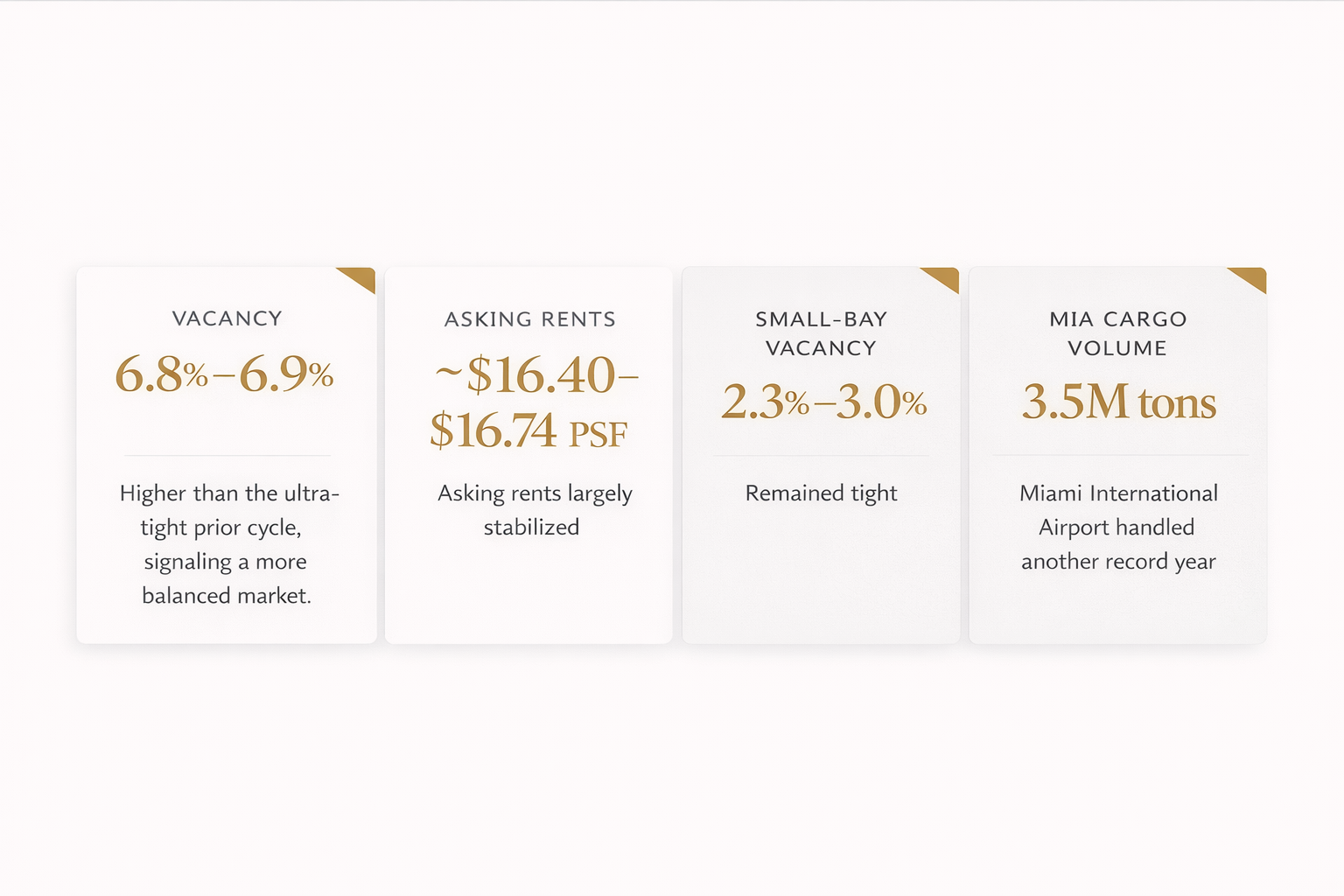
Miami-Dade industrial vacancy rose to about 6.8% to 6.9% by late 2025 as millions of square feet of new space delivered, while asking rents largely stabilized around the mid-$16 PSF range. At the same time, demand remained active, especially in tighter niches like small-bay industrial.
That context matters because many owners are still anchoring to older pricing expectations from the run-up period, while today’s buyers are underwriting more selectively. They are not asking only, “How many square feet is this building?” They are asking, “How durable is this cash flow, how replaceable is this location, how functional is this building, and how much upside is left?”
Why this question is harder to answer in 2026
The problem for warehouse owners is that “the Miami market” is no longer one simple story. Supply has increased, vacancy has moved up from the unusually tight conditions of prior years, and rent growth has moderated. Savills reported Q4 2025 vacancy at 6.9%, which is above the market’s five-year quarterly average of 4.6%, while asking rents averaged $16.40 PSF after softening from earlier highs. Colliers similarly reported 6.8% vacancy and $16.74 PSF NNN rents, describing the market as being in a recalibration phase rather than a collapse.
At the same time, Miami is still one of the country’s most strategically important logistics markets. Miami International Airport said cargo shipments rose 13.6% in 2025 to nearly 3.5 million tons, its sixth straight record year, and PortMiami reported 1,115,058 TEUs in fiscal 2025, marking its 11th consecutive year above 1 million TEUs. Those trade flows continue to support warehouse demand across the county.
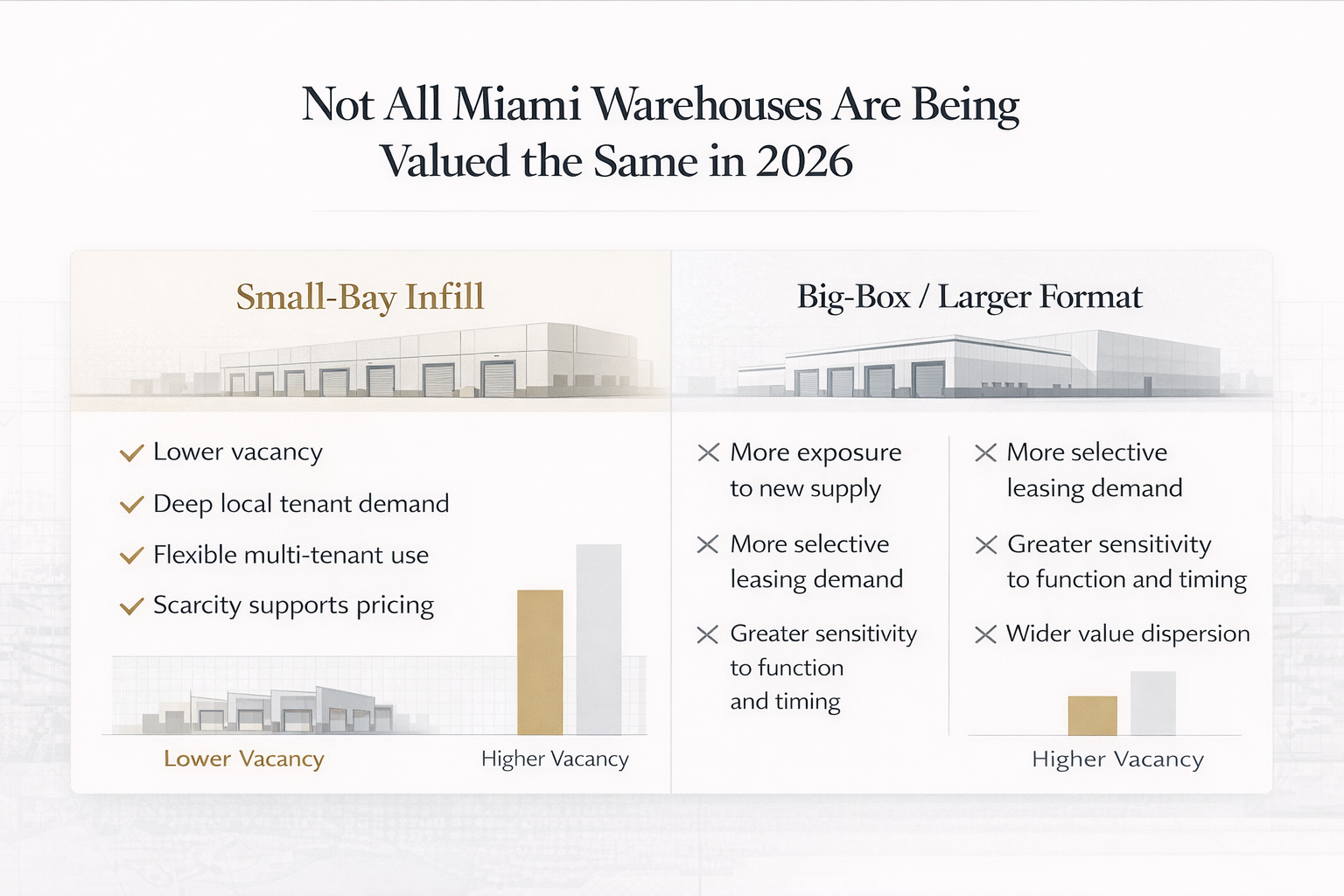
So the answer is not that Miami warehouses are “up” or “down” across the board. The better answer is this: good warehouses in strong infill submarkets can still command premium pricing, while larger, less functional, or more commodity-style buildings face more pressure because buyers now have more choices. That split is showing up clearly in the data. Colliers noted small-bay vacancy around 2.3% to 3.0%, far tighter than the 8.5% to 9.8% vacancy range for big-box product. CBRE also reported that availability remained uneven and more concentrated in larger-format space.
What actually determines your Miami warehouse value
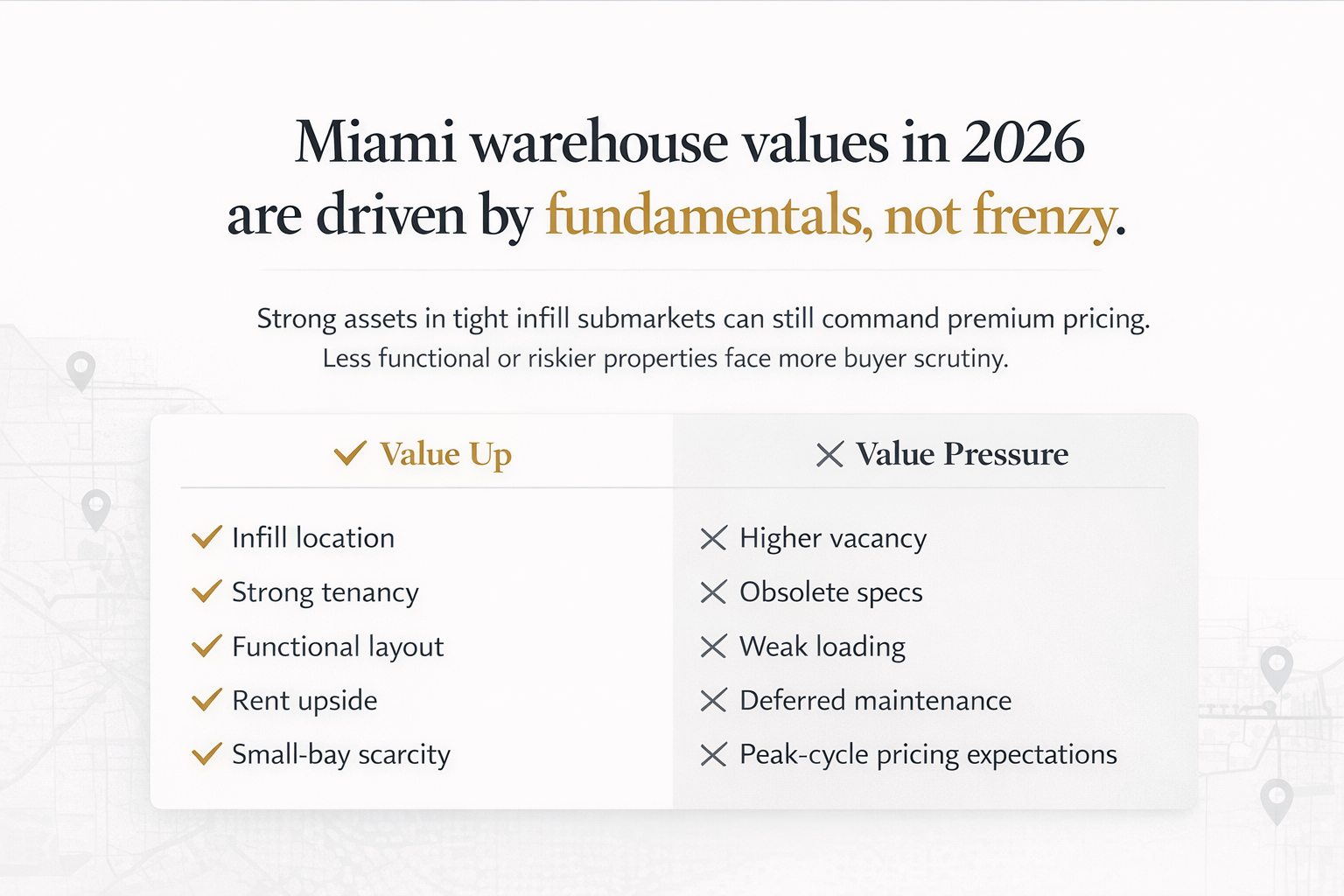
A Miami warehouse is usually valued through some combination of income, comparable sales, land value, and replacement logic. But in practice, buyers are paying for five things.
1. Cash flow today
If your property is leased, the first question is how much net operating income it produces now. A warehouse with strong in-place rent, stable occupancy, and a clean expense profile will usually trade better than a vacant or underperforming property. Buyers care about the reliability of that cash flow, not just the gross rent number.
2. Cash flow growth tomorrow
A building can be worth more if rents are below market and there is credible mark-to-market upside. But in 2026, buyers are underwriting that upside more cautiously because rent growth has cooled. Savills said cumulative rent growth in Miami industrial over the last two years was only 2.1%, a sharp slowdown from the explosive growth period earlier in the cycle.
3. Location scarcity
A warehouse in Doral, Medley, Airport West, Hialeah, Miami Lakes, or another infill logistics node can trade very differently from a similar-size asset in a weaker or less connected location. Proximity to labor, major highways, the airport, and the port still matters enormously in Miami because the region remains a trade-driven and last-mile-sensitive market. That importance is reinforced by MIA’s record cargo volumes and PortMiami’s continued container throughput.
4. Building functionality
Clear height, truck court depth, dock-high versus grade-level loading, circulation, parking, trailer storage, and bay layout all affect value. In a more selective market, functional buildings hold value better because they can attract a wider range of tenants and reduce leasing risk. This is one reason larger-format availability has become more uneven: not every big building is equally desirable, even if the square footage looks impressive on paper.
5. Risk
Lease rollover risk, vacancy risk, deferred maintenance, tenant credit, and future capital expenditures all reduce what a buyer is willing to pay. In 2026, that discounting is more visible because the overall industrial market has moved into a rebalancing phase nationally, with vacancy stabilizing and new supply slowing after a period of oversupply.
A clear answer: how owners should think about value in 2026
For most owners, the clearest answer is this:
Your Miami warehouse is likely worth more in 2026 if it is well-located, highly functional, and either leased at strong terms or positioned for realistic rent growth. It is likely worth less than peak-market expectations if it has leasing risk, functional obsolescence, too much vacancy, or pricing assumptions based on 2022–2023 conditions.
That means value is not being erased across the board. It is being sorted. The market is rewarding quality and punishing weaknesses more clearly.
Why some Miami warehouses may be worth more than owners expect
Small-bay and infill industrial owners may still be in a stronger position than they realize. Colliers reported small-bay vacancy in the 2.3% to 3.0% range, which is extremely tight compared with the broader market and dramatically tighter than the big-box segment.
That matters because small-bay industrial often benefits from deep local demand from distributors, contractors, service businesses, e-commerce support users, and light industrial tenants who need close-in locations and cannot easily relocate far from Miami’s core demand centers.
Multi-tenant small-bay buildings can also create value through diversification and lease rollover upside. In a market where rents are no longer jumping indiscriminately, buyers may still pay well for flexible product with durable tenant demand and scarcity value.
Why some warehouses may be worth less than owners hope
The flip side is that many owners are still quoting numbers based on old comps or broad Miami headlines instead of today’s underwriting reality.
Your warehouse may be discounted in 2026 if it has low clear heights, weak loading, poor truck maneuverability, excess vacancy, major deferred maintenance, or rents that are already at or above what today’s market can easily support.
Larger-format space has seen more pressure as supply expanded. Colliers, Savills, Cushman & Wakefield, and CBRE all pointed to higher vacancy or uneven availability tied to recent deliveries and larger-format product. Cushman also noted roughly 1.3 million square feet remained under construction entering 2026, with about 80% of that space available at the time of reporting.
That does not mean big-box assets have no value. It means buyers have become more disciplined. Lease quality, tenant demand, and functionality matter more now because supply is no longer as constrained as it was.
How leased and vacant warehouses are valued differently
A leased warehouse is often priced on current income and the certainty of that income stream. Buyers will examine net operating income, rent level, lease term, escalations, renewal probability, and tenant credit. A fully leased building with stable expenses and attractive remaining term may command a premium because the buyer is purchasing predictability.
A vacant warehouse is underwritten differently. Buyers focus on market rent assumptions, lease-up timing, tenant improvement costs, leasing commissions, downtime, and the risk that rents soften before stabilization. In a market with 6.8% to 6.9% vacancy, vacancy is not fatal, but it does force sharper scrutiny.
This is why two nearly identical buildings can trade at very different values. One is selling proven cash flow. The other is selling a business plan.
The practical formula buyers are using
Most buyers are effectively asking:
What is the property earning now? What can it earn next? How risky is that path? How scarce is this location? How replaceable is this building?
That is the real formula behind value in 2026. Not just price per square foot.
Price per square foot is useful as a comparison tool, but it can mislead owners when used alone. Two warehouses of the same size can have very different values based on location, bay depth, loading, office buildout, occupancy, rent level, and land coverage. In a more normalized market, those differences show up more clearly in pricing.
How to estimate your warehouse’s value before calling a broker
Start with the basics. Gather the facts a buyer would immediately request: building size, land size, year built, zoning, clear height, loading, parking, power, current occupancy, lease terms, rent roll, operating expenses, and known capital needs.
Then look at comparable sales, but only those that truly resemble your asset. Same submarket. Similar size. Similar functionality. Similar occupancy profile. A small-bay multi-tenant building in Hialeah should not be benchmarked casually against a large modern distribution facility in a different part of the county.
Next, compare your current rents to the market. This is where many owners find hidden value or hidden weakness. If your rents are below today’s achievable levels and the tenant profile is healthy, there may be upside. If your rents are already stretched and your leases are short, value may be more fragile than the current income suggests. Rent stabilization around the mid-$16 PSF range is one reason this step matters so much in 2026.
After that, estimate stabilized NOI. For leased properties, that means real NOI based on actual income and expenses. For vacant or partially vacant assets, it means what a buyer can reasonably stabilize after downtime and leasing costs.
Finally, apply a realistic yield expectation. Even without quoting one universal cap rate, the principle is simple: the more risk, the higher the return a buyer will demand, and the lower the value they will pay.
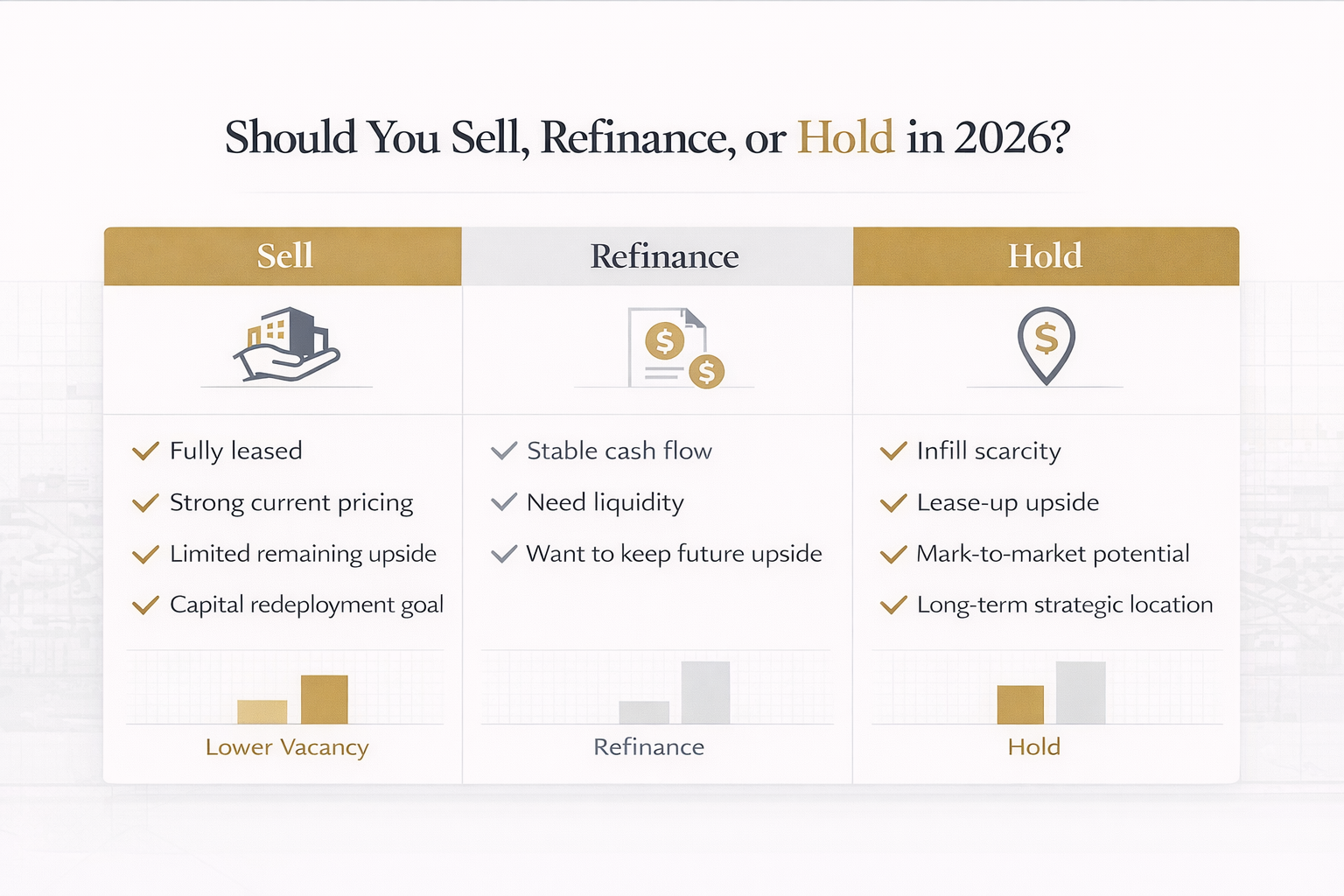
Should you sell, refinance, or hold?
That depends on what is creating your value today.
Selling may make sense if your warehouse is fully leased, rents are near market, the property is highly functional, and buyer demand for your asset type remains strong. This can be especially attractive for owners who have already captured most of the upside and want to redeploy capital.
Refinancing may make more sense if the property has stable income and you want liquidity without giving up future appreciation or rent rollover upside.
Holding may be the best move if your submarket is still supply-constrained, your building has lease-up or mark-to-market opportunity, or your asset sits in a scarce infill location with long-term strategic value. That argument is stronger in Miami than in many markets because of the region’s freight and trade infrastructure. MIA’s record cargo year and PortMiami’s continued million-plus TEU performance both support the long-term relevance of well-located industrial assets.
Bottom line
So what is your Miami warehouse worth in 2026? It is worth the present value of its income and upside, adjusted for its risk, in a market that has shifted from frenzy to fundamentals.
Miami industrial is still supported by strong logistics demand and global trade infrastructure, but valuation in 2026 is more selective because vacancy is higher, rent growth has moderated, and buyers are distinguishing much more sharply between premium infill product and more commodity-like space.
For owners, that is actually good news. It means the path to higher value is clearer: improve functionality, strengthen occupancy, document your upside, and price the asset based on today’s market rather than yesterday’s peak.