Why Miami’s Small Industrial Market Is Behaving More Like Residential Real Estate

Why Miami’s Small Industrial Market Is Behaving More Like Residential Real Estate
Miami’s small industrial market, particularly 1,400 to 5,000 square foot units, has begun behaving more like residential real estate than traditional commercial property.
Prices exceeding $300 per square foot, quick financing approvals, and emotionally driven owner-user buyers are increasingly shaping the market. In this segment, cap rates and traditional underwriting often play a minimal role, while scarcity, replacement cost, and operational necessity dominate decision-making.
This shift matters because it means small-bay industrial assets in Miami are being priced differently than larger institutional industrial buildings. Owners, investors, and brokers who evaluate these properties strictly using income metrics may misread the market and miss opportunities.
Understanding why this segment behaves differently requires examining the structure of the buyer pool, the supply constraints in key submarkets, and the psychology driving many transactions.
Small-Bay Industrial Is Being Priced Like Housing
The clearest explanation is simple: the dominant buyers in this segment are owner-users, not investors.
When a logistics operator, contractor, distributor, or import/export business purchases a small industrial unit, they are typically evaluating the property based on business needs and long-term stability, not yield.
Instead of asking:
“What cap rate does this property produce?”
They often ask:
“Will my mortgage payment be similar to or lower than my rent?”
“Can I replace this space later if I sell?”
“Will rents keep rising if I don’t buy?”
That framework closely resembles residential home purchasing logic rather than institutional commercial investment analysis.
Miami’s Industrial Market Has Been One of the Strongest in the U.S.
Miami’s broader commercial real estate market has experienced rapid growth due to strong population inflows, international capital, and expanding logistics demand.
Industrial space is especially tight. Average warehouse lease rates in Miami are now around $14–$18 per square foot in key submarkets such as Doral and Airport West, among the highest in the Southeast.
Sale pricing has also surged. Industrial properties in Miami-Dade County average roughly $440 per square foot, reflecting intense competition for limited supply.
However, these averages hide an important detail: not all industrial properties behave the same.
Large distribution warehouses operate under institutional investment rules. Small-bay industrial units do not.
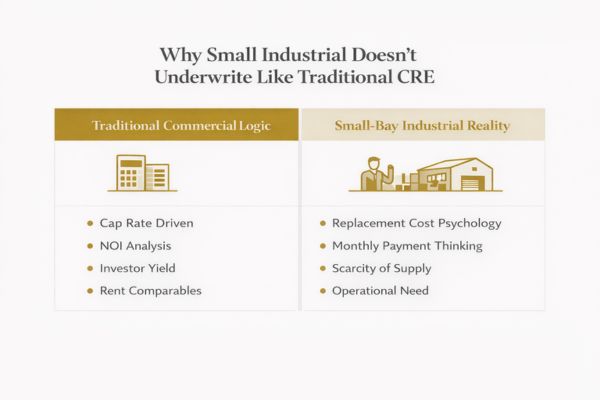
Traditional Underwriting Doesn’t Explain These Deals
In typical commercial real estate investing, buyers evaluate assets based on:
Net operating income (NOI)
Cap rates
Comparable investment sales
Yield relative to interest rates
But for small industrial condos and units, those metrics often fail to explain actual transaction pricing.
For example, listings in Miami-Dade show smaller industrial properties trading at $300 to over $400 per square foot, with some units even exceeding $450 per square foot depending on size and location.
If evaluated strictly as income property, many of these deals would appear overpriced relative to rents.
Yet they continue to trade quickly.
The reason is that buyers in this segment aren’t primarily investors.
The Buyer Pool: Owner-Users Drive the Market
Most small industrial properties between 1,400 and 5,000 square feet are purchased by businesses that intend to occupy the space.
Common buyers include:
Import/export operators
Small logistics companies
Contractors and construction firms
Distribution businesses
Service providers and light manufacturers
For these buyers, the property functions as operational infrastructure, not purely as a financial investment.
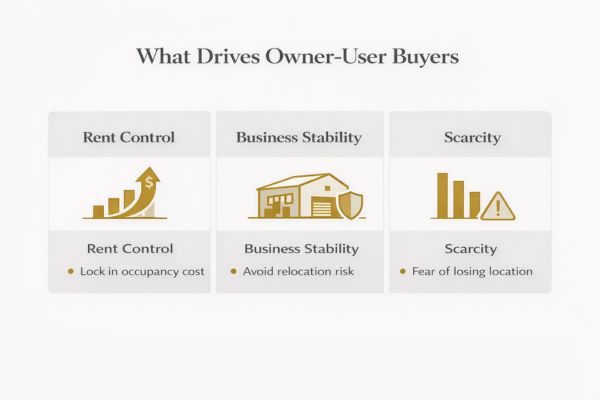
Owning the space offers several advantages:
1. Rent Control
Industrial rents in Miami have surged over the past decade, making long-term leases uncertain.
Ownership protects businesses from future rent spikes.
2. Business Stability
Industrial operations depend on reliable locations. Moving warehouses is expensive and disruptive.
Ownership provides long-term operational control.
3. Financing Availability
Banks are often comfortable lending on owner-occupied industrial property, which can accelerate transaction timelines.
Replacement Cost Psychology Is Driving Pricing
One of the strongest forces behind small-bay pricing is replacement cost psychology.
Buyers frequently ask a simple question:
If I don’t buy this space now, will I ever be able to replace it later?
In markets like Miami, where land is scarce and industrial zoning is limited, the answer is often uncertain.
That scarcity pushes buyers to focus less on cap rates and more on long-term availability.
This mindset mirrors residential home buying, where buyers frequently pay premiums to secure housing in desirable neighborhoods.
Emotional Buyers Are Accelerating Competition
Another factor reshaping the market is buyer psychology.
Unlike institutional investors, who follow strict underwriting guidelines, owner-users often make decisions based on:
Urgency
Operational needs
Scarcity of available units
Many business owners think in practical terms:
“If I don’t buy now, I may lose this location.”
“My rent will keep increasing.”
“My business needs this space to grow.”
These motivations create competitive bidding environments similar to housing markets, where price sensitivity declines as scarcity increases.
Where This Trend Is Most Visible
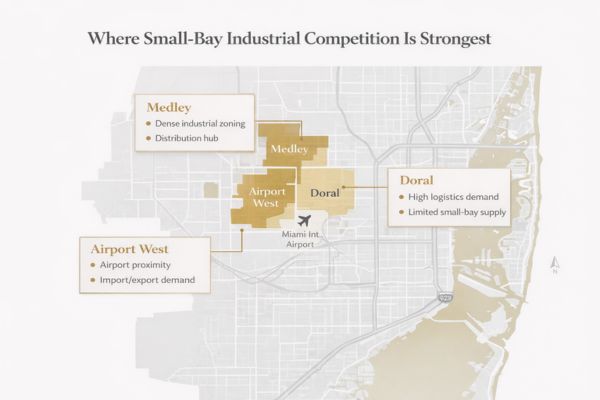
This behavior is most pronounced in several key Miami submarkets:
Airport West
A major logistics hub near Miami International Airport, making it extremely valuable for import/export businesses.
Doral
One of Miami’s most established industrial corridors with strong access to highways and international trade.
Medley
A dense concentration of warehouse distribution facilities serving regional logistics networks.
These areas combine limited supply, high demand, and strategic location, which drives intense competition for smaller spaces.
Why This Matters for Industrial Owners
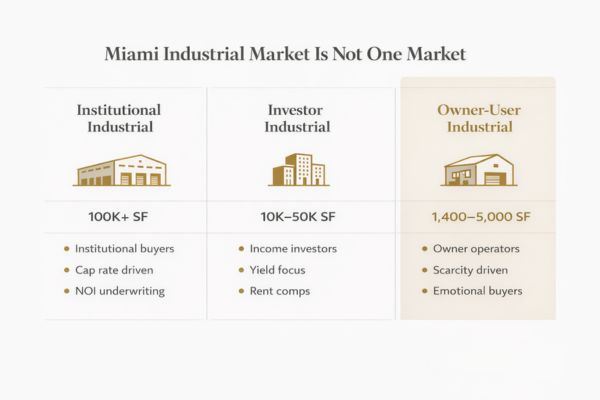
The biggest takeaway is that Miami’s industrial market is no longer a single market.
It has effectively split into multiple parallel markets, including:
Institutional logistics warehouses
Investor-owned industrial properties
Owner-user small-bay industrial units
Each operates under different pricing dynamics.
For owners of small industrial buildings or condos, this means:
The highest bidder may not be an investor
Marketing strategy matters more than ever
Pricing may be driven by business demand rather than cap rates
Understanding which buyer pool applies to your property can significantly influence valuation, timing, and deal structure.
Expect Small Industrial Pricing to Stay “Illogical”
Looking forward, small-bay industrial will likely remain illogical on paper but extremely competitive in reality.
Several forces support this trend:
Continued growth in Miami’s logistics economy
Limited industrial land supply
Strong small-business demand for ownership
Financing availability for owner-users
Unless a large wave of new small-bay development enters the market, this segment will likely continue to trade differently from institutional industrial assets.
The most important insight for owners is simple:
Miami’s industrial market isn’t one market right now.
It’s multiple markets running in parallel.
And in the small-bay segment, how your deal gets done may matter just as much as where your building is located.